Why Do Art Museum Workers Leave The Field?
Museum Moving Forward’s research just lifted the curtain on a well-known reality museum professionals usually prefer to remain silent about - poor management, low salaries, and a lack of opportunities are top reasons why museum professionals are leaving the field.
The MMF conducted research to define former American art museum workers as anyone who has retired, resigned, quit, been laid off, ended a temporary contract, or been involuntarily terminated from a position in an art museum and has not yet returned to a job in the sector. MMF distributed the survey through its social media channels and by sharing it with aligned organizations. The survey was conducted from May to July 2026, during which time they received 681 responses. After that, the organization conducted three focus groups to gather qualitative insights from respondents, complementing the largely quantitative data from the survey.
Survey’s top findings look like this:
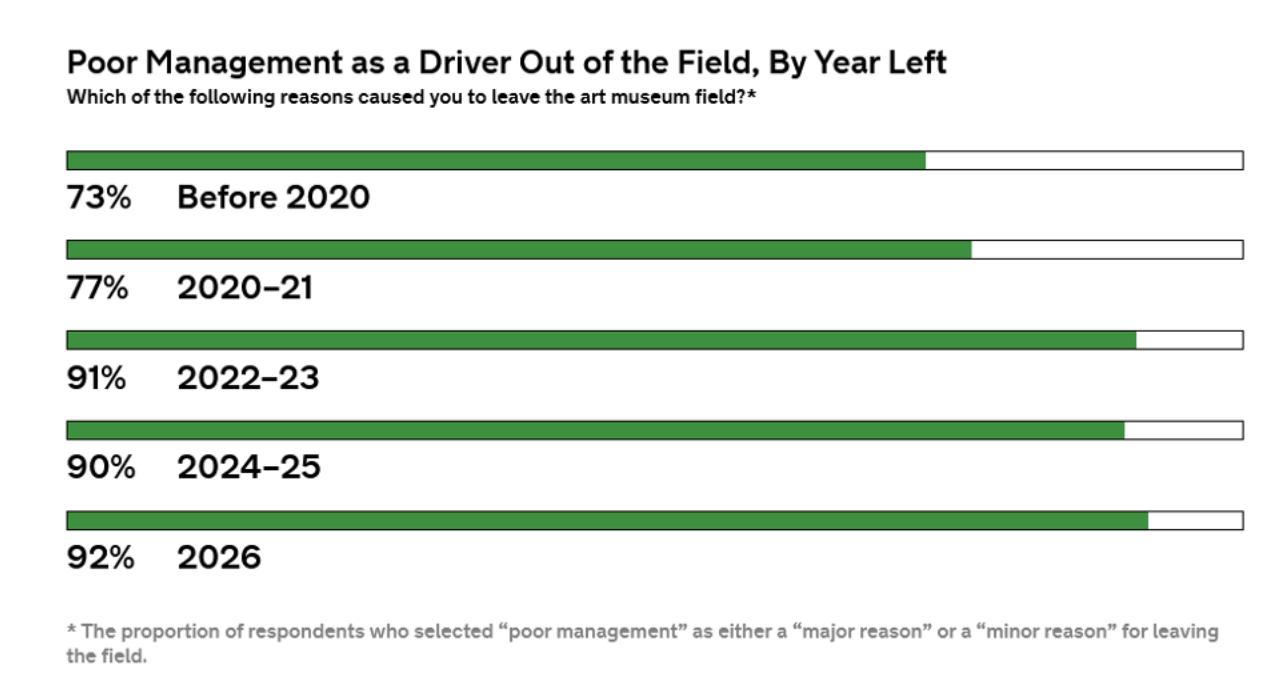
Poor management is the top reason workers have left the field, and it has grown steadily since 2020.
Nearly half (47%) of workers did not have another job lined up prior to leaving the field.
Workers are finding better conditions outside art museums: 73% have more flexibility, 64% earn more money, and 55% have more opportunities for advancement.
Fewer than a quarter (23%) of former art museum workers would unequivocally return to work in the sector, but 63% say they would return under special circumstances.
The majority (54%) of diversity, equity, accessibility, and inclusion (DEAI) committee members who left the field between 2022 and 2024 were much more likely to do so because they lost faith that art museums were changing for the better.
The fact that nearly 700 people, who invested in the museum field with their intellectual ability and hard work, took the time to complete a survey is a sign that their voices must be heard and considered for the better future of the art museum field.
Below are the unchanged highlights from the MMF’s survey.
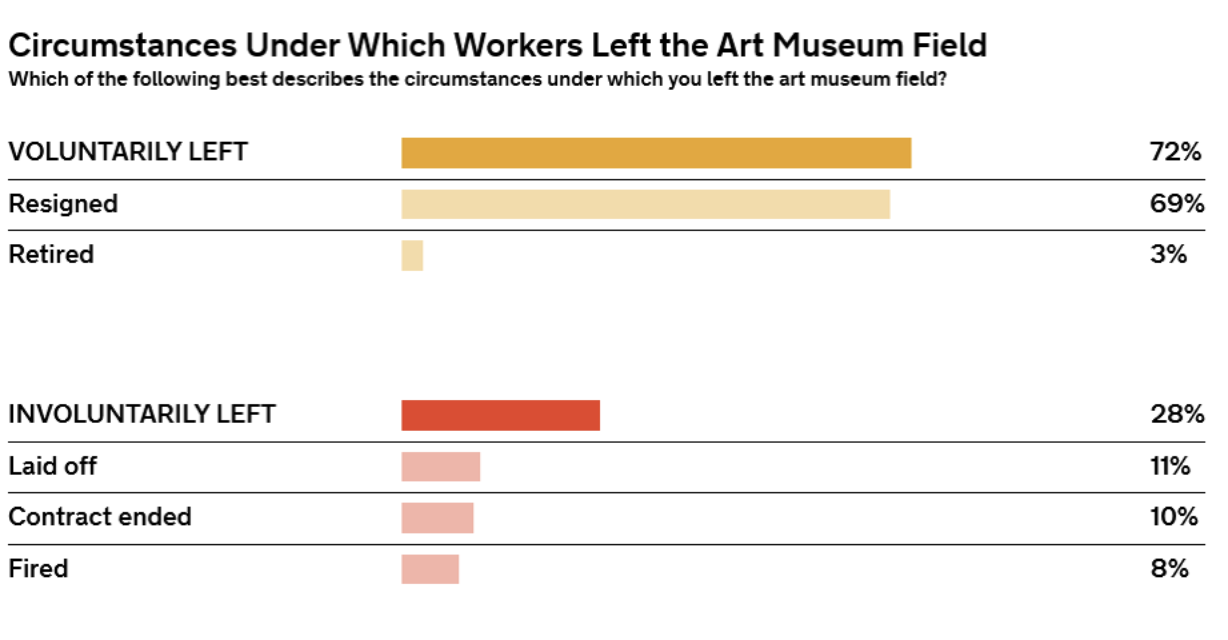
The MMF organized departures into two categories: voluntary (resignations and retirements) and involuntary (layoffs, firings, and contract endings). Nearly three-quarters (72%) of respondents left the field voluntarily, while 28% left involuntarily.
However, this binary classification between voluntary and involuntary departures does not fully capture the complex circumstances under which some workers left. A significant proportion (44%) of workers who left voluntarily say they felt pushed out. Dozens of respondents didn’t see their experiences fitting neatly within one of the five given options above and offered write-in responses. These responses reflect the specific pressures or complex dynamics facing some workers before they decided to leave. One respondent said they “quit due to union busting,” while another shared “I was pushed out by abuse but ultimately resigned.”
Nearly three-quarters (72%) of respondents had been working in the field for more than five years, with one-third having worked more than ten years.
Many former art museum workers say they felt they had to leave the field after many years trying to make it work within their museum or after several jobs across different museums. As one person shared, “I found myself in the same environment repeatedly across four institutions (of various sizes and operating budgets). It was time for me to pivot and find alignment elsewhere.”
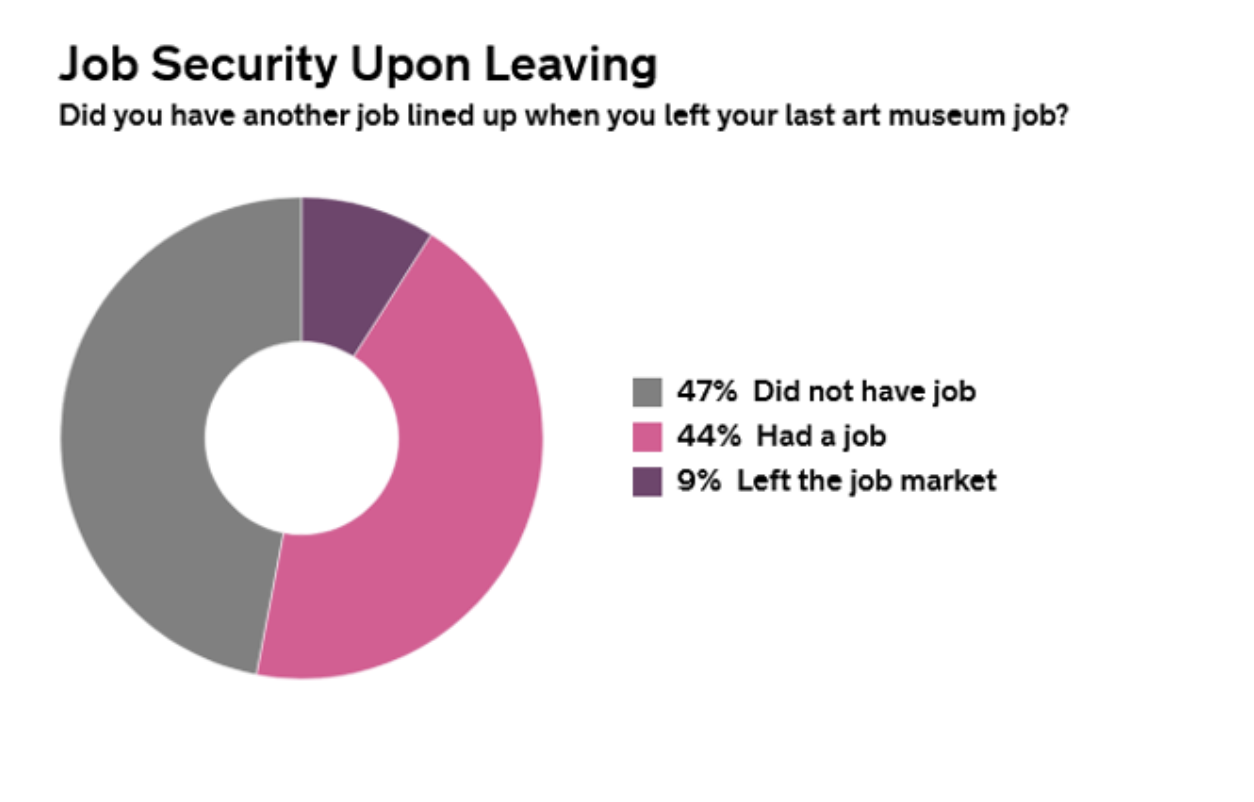
Another way MMF understands the circumstances of a worker’s departure is by perceived urgency and whether or not they had another job lined up before leaving. Nearly half (47%) of workers did not have another job lined up prior to leaving the field.
Unsurprisingly, this is most acute for those who left involuntarily: the vast majority (81%) say they did not have another job lined up before they lost their position. For those who resigned voluntarily, one-third (34%) of respondents did so before securing another job, indicating a desire to leave quickly or some measure of duress.
The vast majority (79%) of respondents left the field in 2020 or later. However, it is important to note this does not necessarily correlate to a period of increased workforce churn in the sector. This might simply be because of higher levels of engagement from recent departures.
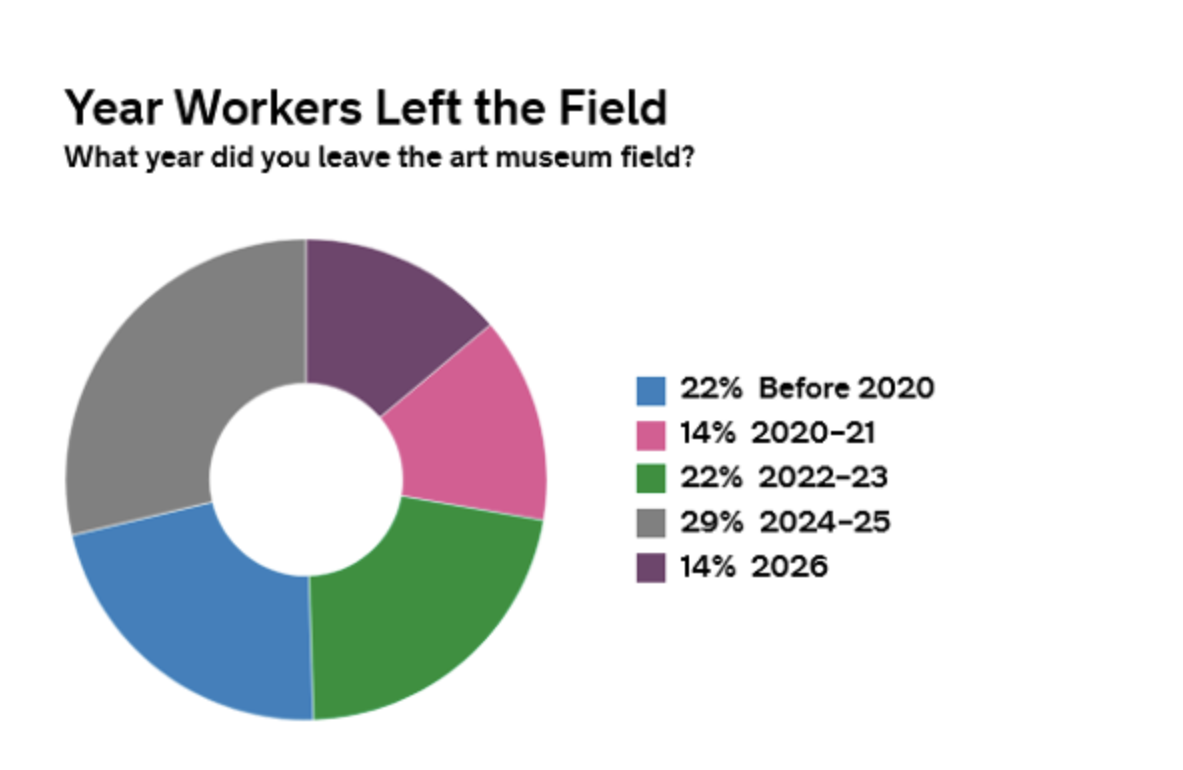
The art museum workforce mirrored broader US workforce trends over the last six years. Art museum workers were twice as likely to have been laid off in 2020–21 (20% were laid off during that time period vs. an 11% layoff rate overall), during the peak of the COVID-19 pandemic. This period was marked by mass layoffs and furloughs, when museum attendance declined dramatically, causing sharp revenue decreases and budget cuts. Correspondingly, art museum workers were much more likely to have resigned during 2022 and 2023 (80% resigned during that time period vs. a 69% resignation rate overall). The “Great Resignation” peaked in 2022, a period during which more than 50 million workers quit their jobs nationwide, a US record.
The top reasons current workers are considering leaving the art museum field—low pay, burnout, and lack of opportunities for growth—are consistent across both of MMF’s studies to date. Former art museum workers echo these reasons for departing with one notable addition: poor management is the number one reason people left the field.
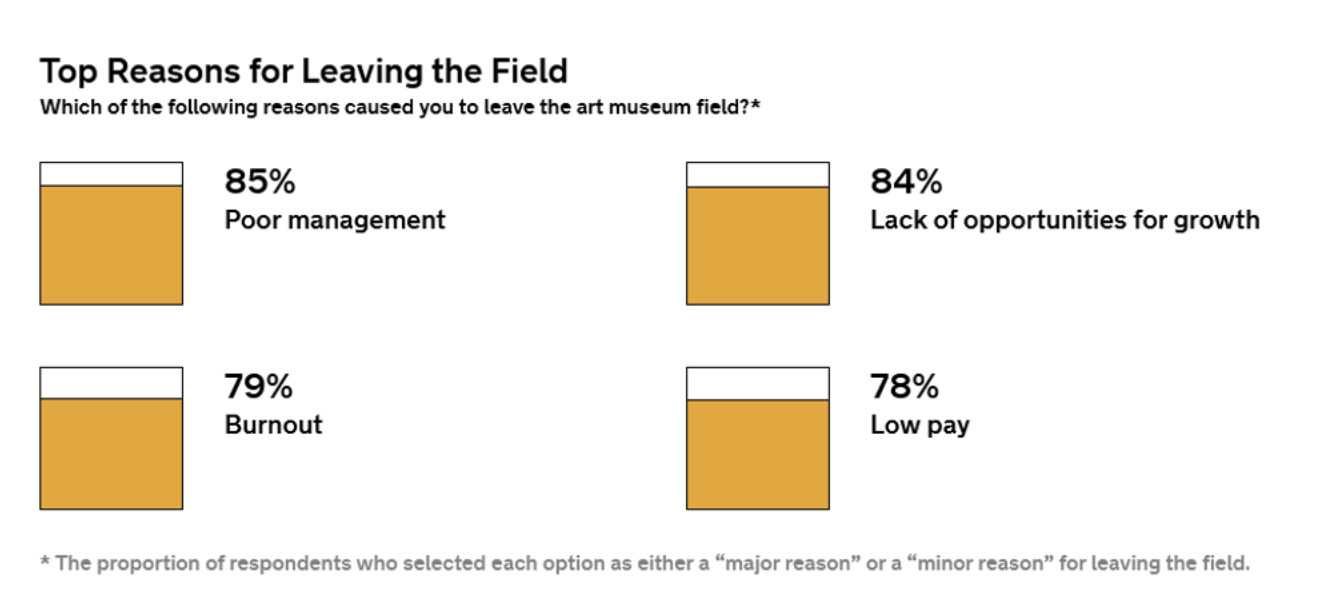
The vast majority (85%) of respondents say that poor management was one of the reasons they left the field, and two-thirds (66%) say it was a major reason for their departure. Survey respondents were asked to identify each reason for leaving as a “minor reason,” a “major reason,” or “not a reason.” Poor management was both the most common response (major and minor) and the most common “major reason” for leaving, followed by lack of growth opportunities (56% say it was a major reason), burnout (55% say it was a major reason), and low pay (53% say it was a major reason).
The majority of focus group participants and survey respondents pointed to executive-level staff, particularly the museum’s director, as the primary example of poor management. We conducted three focus groups with a total of 32 participants and reviewed 406 open-text responses to the following question: “What special circumstances would allow or encourage you to return to work at an art museum?”; “Why would you never work at another art museum?”; and “Is there anything else about your experience at an art museum that you would like to share?”
However, respondents' critiques often focused on those responsible for hiring and managing the director, namely the board. As one survey respondent shared: “In my experience, long-standing governance dynamics can become the greatest barrier to organizational health, yet boards are often reluctant to acknowledge or address their own role in recurring challenges.”
Even issues with nonexecutive management (department directors or direct supervisors) were often tied back to concerns about executive- and board-level leadership. As one focus group participant stated: “Everyone saw the poor management and unsustainable pay and was just letting it happen.”
What behaviors are associated with poor management?
Lack of transparent communication, especially in moments of crisis.
Unskilled or untrained management.
The other top-cited reasons for leaving the art museum sector—burnout, low pay, and lack of growth opportunities—were frequently connected back to poor management. Ultimately, all other issues are viewed as downstream of poor management. As one focus group participant put it: “Management is an expression or manifestation of institutional values: whose perspective, work, experience, safety, or feedback is valued.”
For both current and former art museum workers, low pay, burnout, and a lack of opportunities are top drivers for leaving the field. However, MMF also sees a few notable differences when comparing the reasons for leaving between those considering leaving and those who did. Former art museum workers cite interpersonal problems—poor management, issues with other staff members, and feeling pushed out—at much higher rates than current workers. While the material challenges of the job (low pay, lack of growth opportunities) are felt across both groups, it is clear that interpersonal issues have an outsized impact on those who ultimately end up leaving the field. This points to a culture problem in the field beyond just structural limitations of working in museums or the nonprofit sector.
Staff who were part of their museum’s DEAI committee had established long-term careers in art museums. Over three-quarters (79%) of DEAI committee members had worked in the field for over five years, and 40% for more than ten. They were drawn to this work because of their commitment to art museums but faced frustrating or even intractable challenges that led, in part, to them deciding not only to leave their jobs but the field altogether.
Many DEAI committee members say they had been inspired by the statements their museum’s leadership had made about transformational change. They shared how early conversations felt exciting, with one focus group member sharing how “change seemed possible and quick.” Some were hired explicitly to support these change efforts through grants and new initiatives geared towards advancing equity within and across their museums.
However, optimism dwindled as several of these new hires said they were brought on under false pretenses or into environments resistant to the very changes they were hired to enact. One respondent shared: “The culture we encountered was actively opposed to the principles that the institution purported to represent during the hiring process, and we were actively blocked from carrying out some of the DEAI-focused activities the positions were purported to be responsible for.” Another pointed to management as a primary obstacle: “[M]anagement in museums claims to be very open-minded and encourages DEAI. In practice, they are set in their ways, discriminatory, and exploitative.”
The full survey is available on MMF’s website.
